16 Iranian fishermen missing for 3+ months, US helicopter last seen overhead
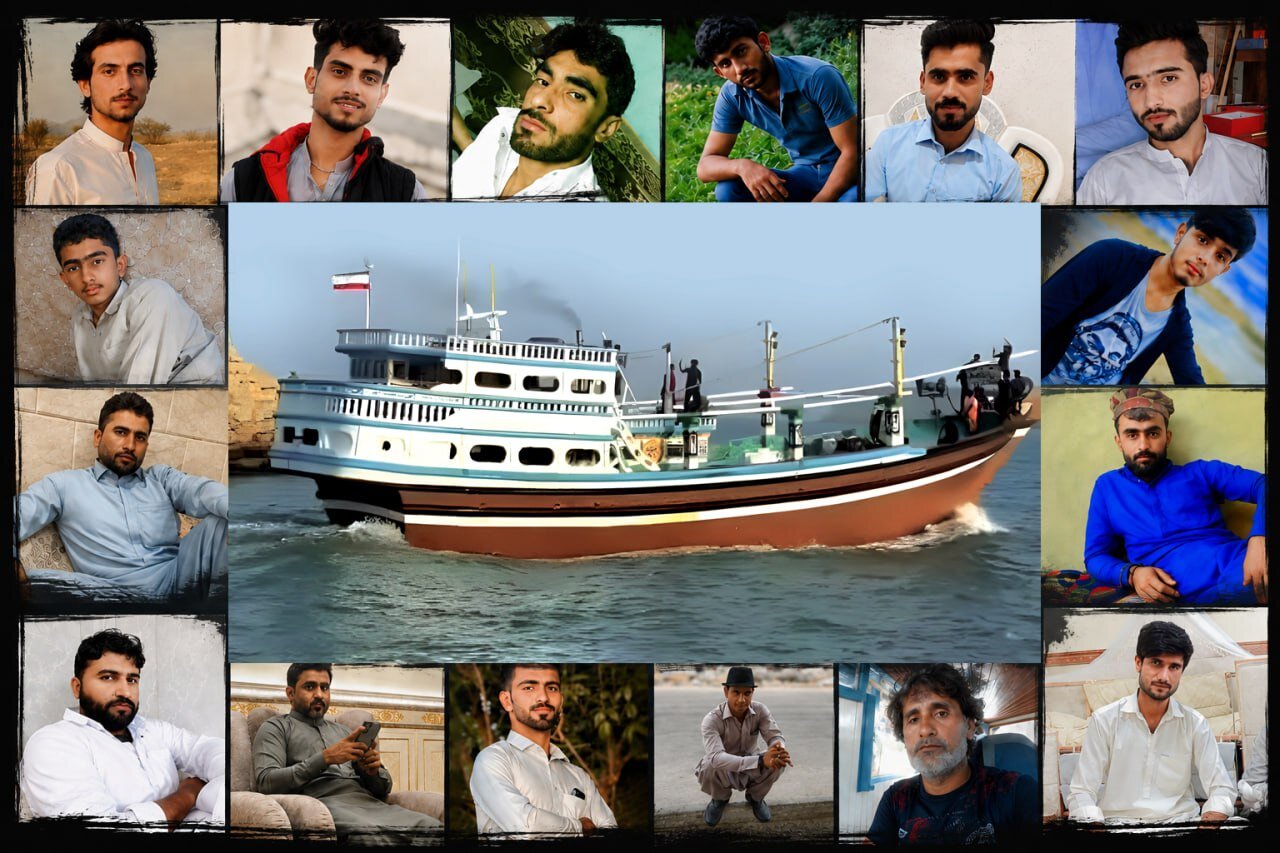
TEHRAN- A warm wind blows from the coast of Konarak toward the sea, but at the city's fishing port, the familiar excitement of returning fishing boats has disappeared. More than three months have passed since the day the fishing vessel Shahin 2, carrying 17 fishermen, disappeared in waters near Oman. The incident remains without a clear explanation, leaving dozens of women, men and children waiting for news of their loved ones.
Konarak, in southeastern Iran along the coast of the Sea of Oman, is a city whose economy and daily life are closely tied to the sea. For many families in the region, fishing is not merely a job; it is a family tradition and their only means of making a living. Many men go to sea with their fathers from childhood and, years later, continue the same path to provide for their own wives and children.
One of these families is that of Hamid Baluch, the captain of the Shahin 2. His brother, Sajed, told the Tehran Times about a man who spent almost his entire life at sea. He said: “My father started fishing when he was about 11 years old, and my brother Hamid had loved the sea since he was a child. He studied only until the fourth grade of elementary school, but he devoted his entire life to fishing. He worked in this profession for nearly 30 to 35 years and was also the captain of a fishing boat for around 15 to 20 years.”
Captain Hamid and the other crew members of the Shahin 2 had been unable to go to sea for fishing and earn an income during the height of the US attacks, and at the first opportunity after several months, they set out for high s.
Sajed stressed: “All of the people aboard the vessel were fishermen. There were 16 Iranians from Konarak and one Pakistani national on this trip. They had gone to sea solely to work and provide for their families.”
The last voyage of the Shahin 2 began from the Konarak fishing port on May 5, 2026. The destination was open waters and the fishing grounds in the Sea of Oman — a journey that began like dozens of others but never ended with a return home.
The 17 people aboard the Shahin 2 were:
Hamid Baluch, Mehran Ranjbar, Esmail Bakra, Hamed Dehani, Jassem Dehani, Mehrzad Dehani, Adel Razmi, Khaled Razmi, Farid Razmi, Mohammad Razmi, Abdullah Rouhafza, Eghbal Gangzari, Mehran Baluch, Reza Peyrayesh, Mohammad Raeisi, Morabakhsh Nohani, and one Pakistani crew member whose name has not been publicly identified.
Hamid's brother said: “The last news we received came at around 12:30 or 1 a.m. on May 7, when there was still radio contact with the Shahin. We were told that the vessel had been about 80 nautical miles from the Omani coast the previous night and that a helicopter had last been seen flying over it. After that, contact with the vessel was lost, and all the boats were dispersed.”
He stressed that after the sighting of the US helicopter, the fishing vessels in the area moved in different directions to distance themselves from the area, breaking contact with one another. According to the families, this marked the beginning of the uncertainty surrounding the fate of the Shahin 2 and its crew.
But what troubles the families most is not merely the disappearance of a fishing boat; it is the prolonged uncertainty that has continued for more than three months. They say they still do not know what happened to their loved ones, and their only demand is that the truth be established.
This is not the wait of just one family. It is the wait of dozens of children, wives, mothers and fathers who look toward the sea every day for news of their loved ones.
Fishermen who went to sea to make a living
When describing the lives of the fishermen aboard the Shahin 2, Hamid Baluch's brother repeatedly emphasizes that each crew member had his own story of hard work, sacrifice and responsibility toward his family. They had all ventured into open waters simply to earn a living.
Sajed said: “In our city, most people make a living through fishing. If you know Konarak, you can see that the city's economy depends on the sea. A significant portion of the fish needed by the country's processing and canning industries comes from this region. For people here, fishing is not just a job; it is their entire life.”
According to him, many of the fishermen on this voyage were the sole breadwinners of their families, and each trip to sea represented the hope of supporting dozens of people.
Fishing trips usually lasted between 40 and 50 days, and families spent all that time waiting for their loved ones to return.
Sajed Baluch said: “When the boat returned, the children would start waiting several hours in advance. When the door opened and they saw their father, smiles would blossom on their faces and happiness would return to the home. Now those same children and mothers wait behind the doors of their homes every day for the head of the family to return, but this time no one opens the door. The families are worried about the fishermen's safety and fate.”
His account of the Shahin 2 crew goes beyond numbers and names. It is the story of people who each carried the heavy responsibility of supporting a family.
He recalls a 17-year-old who had taken responsibility for supporting his family after his father died and who had gone to sea as a fisherman for the first time.
He also speaks of another fisherman who, despite a physical disability, had continued working because he had two children suffering from thalassemia and needed to keep going to sea to pay for their treatment.
He said: “These people had no other choice. Their lives depended on the sea. If they did not fish, their families would have no income.”
Captain Hamid Baluch was one of them. According to his brother, he had built his entire livelihood and experience around the sea, and now his four children are waiting for him to return.
His brother, speaking in a voice that at times trembles with grief, said: “His youngest child is only three years old. He still does not understand the meaning of this prolonged absence and asks about his father every day. The hardest moment for the family is answering that innocent question from a child: When is my father coming back?”
He said that when the boat was at sea, waiting was normal for the families because everyone knew that fishing trips lasted for weeks.
But now the waiting has taken on a different meaning — a mixture of anxiety, uncertainty and a hope that becomes harder to sustain with each passing day.
The fishermen's families say the men were not involved in politics or military conflicts. Their only concern was to return home safely and provide for their families.
Now, their only demand is that the truth about the fate of these 17 fishermen be established — whatever that truth may be. For the families, ending this prolonged uncertainty is more important than anything else.
They say a hostile helicopter was last seen over the vessel and want to know what happened. Were the fishermen detained? Or did something else happen to them?
How did the last hours before the disappearance of the Shahin 2 unfold? The answer to this question lies in the accounts of fishermen who were in the same waters that night and remember the last radio communications with the vessel.
The last contact: The night the Shahin 2 went silent
The most important part of the families' account concerns the final hours before the disappearance of the Shahin 2 — hours during which, according to fishermen in the area, everything changed within a short period of time.
Hamid Baluch's brother says that, based on information they received from other fishing vessels, the last communications with the Shahin 2 took place in the early hours of May 7, 2026, when the vessel was approximately 80 nautical miles from the Omani coast.
He said: “The last information we received was that a helicopter had been seen flying over the vessel. After that, contact with the Shahin 2 was lost, and we received no further information about its crew. Since we were surrounded, along this route it was not possible for a helicopter from any country other than the United States or the Arab countries to be flying there. That same night, tensions between Iran and the United States had flared up again. Now 90 days have passed, and we still have no clue about the fishermen's whereabouts.”
To clarify the details of that night, I also spoke with Captain Nasir Beybak, a fisherman who was in the same area and whose two relatives, including his cousin Mehran and Captain Hamid Baluch, were among the crew members of the missing vessel.
He recalled: “We were also fishing in the same area. Our boat was about five to six nautical miles from the Shahin 2. On the first night, we were close to each other, but on the second night, we moved a little farther apart.”
Beybak said the last radio contact with the Shahin 2 took place at around 11:30 p.m. to midnight.
“We were informed over the radio that a helicopter was above the vessel. It took no more than three or four minutes before contact was cut off.”
After some time, the same helicopter approached their vessel and remained there until around 2 a.m.
According to the eyewitness, the helicopter circled their vessel several times and ordered them in English to change course.
He said: “The helicopter circled our boat several times. By firing flares and issuing orders in English, it told us to change our course and turn back. To avoid any confrontation, we changed our course. After the helicopter left us, it went back toward the Shahin 2.”
“The helicopter remained in our area for about an hour. Then it went toward Captain Moslem's vessel and Captain Mohsen's vessel before returning to the Shahin 2. A few minutes later, no matter how hard we tried to contact that vessel by radio, we received no response.”
Beybak continued:“We can see all the boats on our radar by their names, and we saw that the communication with the Shahin 2 had completely stopped. The names of vessels are also displayed on the radar systems of other countries and on the helicopter's radar. Countries such as Oman can therefore determine the presence of a vessel through these systems.”
According to him, from that moment onward, the vessel's communication system was no longer active, and there was no indication of its location.
Beybak continued:“After daylight, the other vessels found each other again, but the Shahin 2 was no longer among them. We tried repeatedly to contact it by radio, but received no response, and we obtained no information about its fate. The American helicopter prevented us from going toward the Shahin 2 and drove us away.”
Hamid's brother also said that the families realized from the first hours that something unusual had happened.
“At first, we hoped it might have been a technical problem or a temporary loss of communication. But as time passed, our concern grew. Today, more than three months have passed since that night, and we still have no definitive information about the fate of our loved ones.”
The families emphasize that their goal is not to accuse any party. They simply want to know what happened to the Shahin 2 and its 17 crew members after the last contact and the loss of communication.
For them, every day that passes without an answer is a continuation of that long night — a night that began with a radio call and has continued with a silence that has yet to be broken.
Waiting, debt and homes hose breadwinners never returned
For the families of the missing fishermen, the crisis is not limited to the lack of information about their loved ones.
More than three months after the disappearance of the Shahin 2, many of these families are also struggling with financial hardship and heavy debts, because in many cases the missing men were the sole breadwinners.
Hamid Baluch's brother said: “Fishing is not a stable job. Every time the boat goes to sea, it takes about 40 to 50 days to return. Families depend on this income, and their lives revolve around these trips.”
Referring to his own family's financial situation, he added: “The boat was the result of about 40 years of our father's hard work and effort. We have been left with heavy debts for building, equipping and continuing to operate it. Today, we owe around 30 billion tomans to the market. This happened to us during the war, and alongside this financial pressure, we still do not know what happened to our loved ones.”
According to him, if the incident had not occurred, the family had hoped to gradually repay its debts through continued fishing and income from the sea voyages.
But now all their plans for the future have come to a standstill.
Sajed Baluch said: “If conditions had been normal, we could have continued our lives by working. But now there is no income left, and we still have no information about the fate of our loved ones. The pressure is growing every day.”
Hamid's brother said: “We have given up everything. We only want to know what happened to them. If there is news, if something has happened, the families have the right to know the truth. This waiting has become harder than the incident itself.”
He believes that alongside efforts to determine the fate of the fishermen, attention must also be paid to the economic situation of their families — families that are now facing financial hardship and heavy debts in addition to the pain of uncertainty.
The search without answers: From embassies to the Red Cross
More than three months into the ordeal, what have the families done to find answers about the fate of their loved ones, and where have their efforts led?
This question can be answered through the families' persistent efforts to pursue every possible lead.
From the first days after contact with the Shahin 2 was lost, the families of the missing fishermen tried every possible channel to find information about their loved ones.
They say they have approached various institutions, written letters, spoken with officials and requested assistance from international organizations, but have yet to receive a clear answer.
Hamid Baluch's brother said: “It does not matter to us where the answer comes from. We only want to know what happened to our loved ones. If they are alive, the families should be informed of their condition, and if an incident has occurred, the truth should be told to us.”
He explained that the families had pursued the matter through Iranian embassies in regional countries, including the Iranian missions in Oman and Pakistan, but said that these efforts had so far produced no clear result.
He also said that the families had corresponded with the International Committee of the Red Cross. They had hoped that the organization could obtain information about the fishermen's fate through humanitarian mechanisms, but at the time of this interview, no definitive response had been received.
Hamid's brother then referred to another incident involving an Iranian fishing vessel during the war.
He said that in that case, too, families initially had no precise information about the fishermen's condition, but later it became known that some of the survivors were being held in Oman.
According to him, the families learned that the fishermen were alive through a phone call from one of them.
He said: “The Omani embassy had not provided any information about those fishermen. By God's grace, a means of communication became available while they were being transferred between two camps, and they were able to contact their families. Meanwhile, the investor of that vessel had contacted the embassy several times but had received no result.”
Referring to that experience, he said: “That is why we have not lost hope. Until definitive information arrives, the families hope that their loved ones are alive.”
At the same time, the prolonged uncertainty and lack of official information have placed enormous psychological pressure on the families.
He said: “Every day, a new rumor emerges. Families are living between hope and despair. But what they want is not a rumor; they simply want the truth.”
Alongside their official efforts, the families have also sought to use the media to keep the case alive.
Hamid's brother said: “We asked journalists to make our voices heard. If this issue remains confined to one city or one province, it may eventually be forgotten. But if the media continue to follow it, perhaps the path toward the truth will become easier.”
He believes that publishing the story in different languages, particularly English and Arabic, could encourage individuals or institutions with information about the incident to share it with the families.
For this reason, the families welcomed media efforts and also provided the journalist with photographs, documents and videos related to the fishermen and the Shahin 2 for use in subsequent reports, so that the human dimension of the incident could become more visible to the public.
One question remains unanswered
Despite all these efforts, one question remains unanswered: What exactly happened to the Shahin 2 and its 17 crew members between the last radio contact and today?
This is the question the families continue to ask of the responsible institutions and all parties that may possess information about what happened.
A common demand: Establishing the truth about the fishermen's fate
For the families of the missing fishermen aboard the Shahin 2, the passage of time has not eased their concerns. Instead, it has made the burden of waiting even heavier.
They say that throughout this period, their most important demand has been neither a political response nor a particular allegation, but simply the truth.
Hamid Baluch's brother said:“We are not looking to blame anyone. We just want to know what happened. These people were not military personnel; they were fishermen. They went to sea every day to work and, after several weeks, returned home with the hope of seeing their families.”
According to the families, the crew disappeared while the region was experiencing heightened military tensions.
They add that even when they contacted journalists to provide information about the case, they hoped that the call might bring news of the fishermen.
They say they are still waiting for any information about their loved ones.
The families say the last information they received from other fishermen was that a helicopter had been near the vessel and that communication had been lost afterward.
They emphasize that any information about the incident could help bring an end to the prolonged wait.
Hamid's brother said: “If anyone knows what happened, they should answer. If they are safe, their families should be informed. If an incident has occurred, the families still have the right to know.”
He also stressed the need to use every available channel to pursue the case, saying:
“We expect all responsible institutions — from maritime and relief organizations to the relevant authorities inside the country — to take every possible step to determine the fate of these people.”
According to him, fishermen in the region continue to work to preserve their economic activity even under difficult conditions because the livelihoods of thousands of people depend on the sea.
He said: “Fishermen do not work only for themselves. When they go to sea, a family is able to live, workers in fish-related factories have jobs, and part of the regional economy continues to move. They are part of the country's economic cycle.”
The families are also calling for attention to the economic conditions of those left behind.
They say that even before the fate of their loved ones is known, many of the families are already facing serious financial pressure.
Hamid's brother said: “When the head of a family is away from home permanently or for an indefinite period, it is not just one person who is absent; an entire life is affected. The children, wives and parents of these people need support.”
In this context, the role of the media has become particularly important for the families.
They hope that publishing the fishermen's stories and recounting the final hours before the disappearance of the vessel will draw greater attention to the case.
During my conversation with the families, I stressed that this report would not mark the end of efforts to follow the case and that attempts would be made to pursue the matter through discussions with officials and relevant institutions.
The end of a report, the beginning of a wait
Now, more than three months later, the families of the Shahin 2 continue to live with one shared question:
Are their loved ones somewhere waiting to return, or has another fate befallen them?
Answering this question is not merely the families' demand. It is a humanitarian call to end one of the most painful forms of waiting — waiting without news, without a sign and without an answer.
Along the coast of Konarak, life continues.
Fishing boats leave for the sea one after another, fishermen prepare their nets, and families see them off while watching the route they will take on their return.
But for the families of the missing Shahin 2 fishermen, the sea is no longer simply a workplace or a means of earning a living. It has become a symbol of a long wait.
In the homes of these families, the absence of people whose return after every fishing trip was once part of everyday life can be felt everywhere.
Children who once waited to hear their fathers' voices behind the door are now waiting for news that could bring an end to this uncertainty.
Hamid Baluch's brother said: “We still have hope. We pray that wherever they are, they are safe and that good news will come. We only want this waiting to end and for the families to know what happened to their loved ones.”
The story of the Shahin 2 families is not simply the story of a maritime incident.
It is the story of people who spent years working under difficult conditions to provide for their families.
They were not on a battlefield; they were at sea, pursuing their work and their ordinary lives.
Among them was a captain who had known the sea since childhood; fishermen who, despite financial and family difficulties, carried the responsibility of supporting others; and children who are still waiting for their fathers to come home.
This report is the story of families who say that more than anything else, they need answers — answers that can draw a clear line between hope and fear.
The families are calling on all parties that may have information about the fate of the vessel not to remain silent and to provide any information that could help establish the truth to the relevant authorities.
They are also calling for continued official efforts and support for families who, in addition to the psychological burden of uncertainty, are facing financial difficulties because their breadwinners are missing.
Now, more than three months after the last contact with the Shahin 2, one question remains — a question repeated in homes across Konarak, among the fishermen's families and by the children waiting for their fathers:
What happened to the 17 people aboard the vessel?
Until a clear answer is found, the families of the Shahin 2 will continue to wait — a wait in which every phone call, every new piece of information and every small sign could once again revive their hope that their loved ones will return.
The end of this report is not the end of their wait. It is a reminder of a humanitarian demand: that the truth be established and the voices of the families who have spent months waiting for their loved ones to return from the sea be heard.
Leave a Comment